
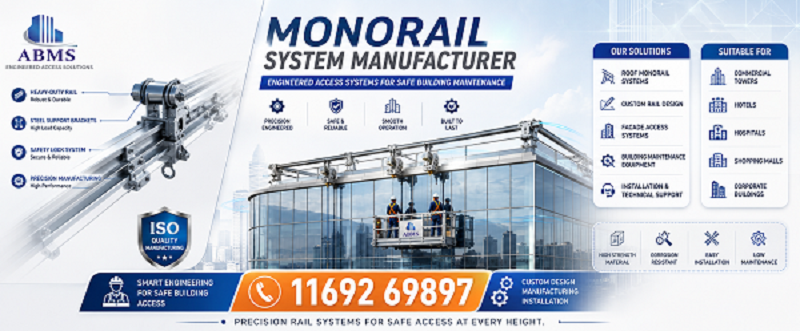
Monorail System Manufacturer | Facade Access Monorail System
A Monorail System Manufacturer plays an important role in providing reliable facade access solutions for high-rise and multi-storey buildings. Modern buildings are increasingly designed with glass curtain walls, aluminum cladding, architectural panels, large windows, and complex exterior surfaces. These structures require regular cleaning, inspection, repair, painting, waterproofing, and other maintenance activities. Accessing these areas safely and efficiently requires specialized building maintenance equipment.
A monorail system provides a practical solution for exterior building maintenance by creating a continuous travelling track along a suitable rooftop or building structure. A suspended cradle, platform, or maintenance unit can be connected to a travelling trolley that moves along the monorail track. The platform can then be raised or lowered to provide access to different sections of the building facade.
ABMS Services provides monorail and facade access solutions for buildings requiring dependable exterior maintenance equipment. Our solutions can be customized according to building architecture, rooftop configuration, facade geometry, working height, platform requirements, and operational needs.
Selecting the correct monorail system requires careful consideration of the building structure and intended application. A professional manufacturer can help evaluate the required track route, suspension arrangement, platform capacity, hoisting equipment, safety features, controls, installation requirements, and maintenance needs.
What Is a Monorail System?
A monorail system used for facade access is a track-based building maintenance system designed to provide controlled horizontal movement for a suspended working platform. The track is generally installed on the roof or an appropriately engineered supporting structure. A trolley travels along this track and supports the suspension equipment connected to the maintenance platform.
The system allows maintenance personnel to position the platform at different locations along the building elevation. The platform can then move vertically using suitable hoisting equipment. This combination of horizontal and vertical movement provides access to large sections of the facade.
Unlike individual fixed access points, a continuous monorail can provide travelling access along a predefined route. This makes it particularly useful for buildings with long facade elevations or multiple maintenance zones.
The exact design of the monorail system depends on the building's architecture, structural capacity, maintenance requirements, working height, platform load, environmental conditions, and applicable safety requirements.
Role of a Monorail System Manufacturer
A professional Monorail System Manufacturer is responsible for developing and supplying equipment that meets the specific requirements of a building maintenance project. Manufacturing is only one part of the overall process. Proper planning, engineering, component selection, installation, testing, inspection, and maintenance support are also important.
A manufacturer generally works with building owners, architects, consultants, contractors, facility managers, and maintenance teams to determine the most suitable system configuration.
The manufacturer may assess the building drawings, roof layout, facade profile, required access areas, operating loads, platform dimensions, and maintenance frequency before developing the proposed system.
ABMS Services focuses on project-specific facade access solutions. Our approach is based on understanding the building's maintenance requirements and providing suitable equipment and technical support.
How Does a Monorail System Work?
The basic operation of a facade access monorail system involves horizontal movement along a track and vertical movement of a suspended platform. The monorail track is installed along the required maintenance route.
A travelling trolley is mounted on the track. The trolley supports the suspension arrangement from which the cradle or working platform is suspended.
Electric hoists or other suitable lifting equipment are used to raise and lower the platform. The operator can position the platform at the required facade location and perform the maintenance activity.
Depending on the system design, the trolley can travel along straight or suitably configured track sections. Curves, corners, transitions, and other track arrangements must be carefully engineered according to the project.
All equipment should be operated by trained personnel and maintained according to manufacturer instructions and applicable safety requirements.
Major Components of a Monorail System
A monorail facade access system consists of several mechanical, structural, electrical, and safety components. Each component contributes to the overall performance of the system.
1. Monorail Track
The monorail track provides the travelling path for the trolley. It must be properly designed and supported according to the expected loads and operating conditions.
Track configuration is determined by the required facade coverage and building geometry. Straight tracks, curved sections, or specially arranged routes may be used where appropriate.
2. Travelling Trolley
The travelling trolley moves along the monorail track and supports the suspension equipment. It may use powered movement depending on the system design.
3. Suspended Platform
The suspended platform provides the working area for maintenance personnel. Platform length, width, capacity, and configuration can be selected according to project requirements.
4. Hoisting Equipment
Hoists are used to raise and lower the suspended platform. Hoist selection depends on building height, platform capacity, rope arrangement, and operating requirements.
5. Wire Ropes
Wire ropes provide the suspension connection between the lifting equipment and the working platform. They should be inspected regularly for wear, corrosion, deformation, and other signs of damage.
6. Control System
The control system allows operators to manage platform and trolley movement. Emergency controls and protective functions can be incorporated according to the system configuration.
7. Safety Devices
Safety equipment may include emergency stopping systems, overload protection, limit switches, anti-tilt mechanisms, safety locks, and other protective devices.
Benefits of a Monorail System
Efficient Facade Access
A monorail system can provide access to large sections of a building facade without requiring separate fixed access points for every maintenance location.
Continuous Travelling Access
The travelling trolley can move along the track, allowing the suspended platform to be positioned at different sections of the building exterior.
Reduced Scaffolding Requirements
For many suitable applications, a monorail access system can reduce dependence on extensive temporary scaffolding for exterior maintenance.
Improved Maintenance Productivity
The ability to position the platform close to the work area can improve productivity during cleaning, inspection, repair, painting, and other maintenance activities.
Long-Term Access Solution
A properly designed permanent monorail system can become part of the building's long-term maintenance infrastructure.
Customized Configuration
Monorail systems can be customized according to building geometry, facade requirements, roof configuration, platform capacity, and maintenance routes.
Applications of Monorail Systems
Monorail systems are widely used for various building exterior maintenance activities. Common applications include:
- Glass facade cleaning
- Window cleaning
- Facade inspection
- Exterior painting
- Waterproofing
- Glass replacement support
- Facade repair
- Sealant replacement
- Cladding maintenance
- Building exterior inspection
- Renovation work
- High-rise building maintenance
Monorail System for High-Rise Buildings
High-rise buildings require specialized access systems because exterior surfaces can be difficult to reach using conventional maintenance methods. A monorail system can provide a dedicated access route along the rooftop and facade.
Commercial towers and residential high-rise buildings with extensive glass facades often require regular cleaning and inspection. A suspended cradle connected to a monorail track can provide access to different areas of the facade.
The system should be designed after evaluating building height, roof structure, facade geometry, required reach, platform capacity, environmental conditions, and maintenance frequency.
Roof Mounted Monorail System
A Roof Mounted Monorail System is installed on a suitable rooftop structure and provides a travelling route for facade maintenance equipment.
Roof-mounted systems are particularly useful where the building requires regular access across long facade elevations. The track can be positioned according to the required maintenance coverage.
Before installation, the roof structure must be evaluated to determine whether it can safely support the proposed system. Structural engineering and professional installation are essential.
Monorail System and BMU Cradle System
A monorail system can form part of a broader building maintenance strategy. A Building Maintenance Unit, or BMU, may include travelling and other mechanisms designed to provide facade access.
A monorail-based suspended platform generally focuses on travelling access along a dedicated track, while a full BMU may incorporate additional functions depending on the building's requirements.
The appropriate system should be selected based on building height, facade geometry, maintenance requirements, operating conditions, and project budget.
Monorail System vs Davit System
Both roof mounted monorail systems and davit systems can provide facade access, but their applications can differ. A davit system generally uses individual davit arms positioned at designated locations, while a monorail system provides continuous travelling access along a track.
A monorail can be advantageous where maintenance teams require regular access across long or complex facade elevations. Davit systems may be suitable where access points are limited and the building configuration allows portable or fixed davit positions.
Selecting between the two systems should depend on building design, maintenance requirements, rooftop configuration, structural considerations, and project budget.
An experienced Monorail System Manufacturer can assess the building requirements and help determine whether a monorail, davit, BMU, or another facade access system is appropriate.
Safety Features of Monorail Systems
Working at height requires strict safety planning. A monorail system should be professionally designed, installed, inspected, tested, and maintained before use.
Emergency Stop System
Emergency stop controls allow operators to stop equipment movement when an abnormal condition occurs.
Overload Protection
Overload protection helps prevent operation beyond the specified safe working capacity.
Limit Switches
Limit switches can help control equipment movement and prevent travel beyond designated limits.
Safety Locks
Safety locking mechanisms can provide additional protection during abnormal operating conditions.
Anti-Tilt Protection
Anti-tilt systems can help maintain platform stability during operation.
Safety equipment should be selected according to the system design and applicable requirements. Operators must also receive appropriate training and follow safe working procedures.
Monorail System Installation
Proper installation is critical to the performance and safety of a monorail system. The installation process begins with an assessment of the building structure and required access route.
The supporting structure must be capable of carrying the applicable loads. Track supports, fasteners, trolley components, suspension equipment, electrical systems, and safety devices must be installed according to the approved design.
After installation, the system should undergo appropriate testing and inspection before being placed into operational service.
ABMS Services provides technical support for facade access system installation and project requirements.
Monorail System Maintenance
Regular maintenance is essential for reliable performance. A preventive maintenance program should include inspection of the monorail track, trolley wheels, fasteners, suspension equipment, wire ropes, hoists, electrical controls, and safety devices.
Operators should report unusual noises, vibration, uneven movement, rope damage, electrical faults, or other abnormalities immediately. Preventive maintenance can identify potential problems before they become serious operational issues.
Choosing an experienced Monorail System Manufacturer such as ABMS Services can provide access to technical guidance and maintenance support for the installed equipment.
Recommended Maintenance Activities
- Inspect monorail tracks.
- Check trolley wheels.
- Inspect structural fasteners.
- Check wire ropes.
- Inspect hoists.
- Test braking systems.
- Check electrical controls.
- Test emergency stop systems.
- Inspect safety devices.
- Maintain inspection records.
Factors to Consider Before Selecting a Monorail System
Building Height
Building height affects wire rope length, hoisting requirements, platform operation, and overall system design.
Facade Geometry
The shape and design of the facade determine the required track route and platform access requirements.
Roof Structure
The rooftop or supporting structure must be evaluated to determine whether it can safely support the proposed equipment.
Platform Capacity
The platform should be selected according to the required number of workers, tools, equipment, and materials within the specified safe working load.
Maintenance Frequency
Buildings requiring frequent exterior maintenance may benefit from a permanent monorail system.
Operating Environment
Wind, weather exposure, building location, and other environmental conditions should be considered during system planning.
Safety Requirements
Safety should remain a primary consideration when selecting and installing any facade access system.
Industries Using Monorail Systems
Monorail facade access systems can be used in many types of buildings and facilities.
- Commercial office towers
- Residential high-rise buildings
- Hotels and resorts
- Hospitals
- Shopping malls
- Airports
- Educational institutions
- Corporate headquarters
- Industrial facilities
- Mixed-use developments
- Government buildings
- Institutional buildings
Monorail System for Glass Cleaning
Glass cleaning is one of the most common applications of facade access equipment. Modern buildings often contain large areas of exterior glass that require regular cleaning to maintain appearance and visibility.
A monorail system can position a suspended cradle close to different areas of the glass facade. This provides maintenance personnel with controlled access for cleaning operations.
Regular inspection of the glass, frames, seals, and surrounding facade elements can also be performed from the suspended platform.
Monorail System for Facade Maintenance
Exterior building maintenance may include cleaning, painting, waterproofing, inspection, sealant replacement, repair, and renovation. A monorail system can support these activities by providing access to elevated facade areas.
Building owners can incorporate the system into a planned maintenance program. Regular access can make it easier for facility management teams to inspect building exteriors and identify maintenance requirements.
Customized Monorail System Solutions
Buildings have different architectural designs and maintenance requirements. Therefore, customized monorail systems may be required for projects with complex facade geometry or specialized access requirements.
Customization may involve track layout, trolley configuration, platform dimensions, suspension arrangement, hoist capacity, controls, safety devices, and rooftop support arrangements.
ABMS Services can provide project-specific solutions based on building configuration, maintenance requirements, and operational objectives.
Monorail System Cost
The cost of a monorail system varies depending on the project. Important factors include track length, building height, platform capacity, trolley design, hoist specifications, suspension arrangement, structural requirements, electrical controls, safety equipment, installation, and customization.
Building owners should consider long-term value rather than evaluating equipment solely on initial purchase price. Quality, reliability, safety, maintenance requirements, spare parts availability, and service support can influence the total cost of ownership.
ABMS Services can help clients evaluate project requirements and identify a suitable monorail configuration.
Permanent Monorail System
A permanent monorail system is incorporated into the building's long-term facade maintenance infrastructure. It can be particularly useful for commercial and residential towers requiring regular exterior access.
Early planning during building design can simplify coordination between the monorail system, roof structure, facade, electrical services, drainage, and other rooftop equipment.
Temporary Monorail and Suspended Access Solutions
Some projects require temporary access equipment for renovation, construction, painting, repair, or maintenance activities. Depending on the project conditions, temporary suspended access solutions may be considered.
Temporary equipment must still be properly installed, inspected, tested, and operated according to applicable safety requirements.
Importance of Operator Training
Operator training is an essential part of safe facade access equipment operation. Workers should understand the equipment controls, safe working load, inspection procedures, emergency functions, fall protection requirements, and operating limitations.
Operators should complete pre-use checks and report any abnormal equipment condition immediately. Only authorized and appropriately trained personnel should operate the system.
Why Choose ABMS Services as Your Monorail System Manufacturer?
Selecting an experienced Monorail System Manufacturer is important for the successful planning and implementation of a facade access system. ABMS Services provides practical solutions for high-rise and multi-storey building maintenance.
Our solutions are designed around project requirements, building architecture, maintenance applications, and operational needs. We focus on reliable equipment, safety-oriented design, professional support, and long-term performance.
- Customized monorail system solutions
- Facade access equipment
- Project-specific system planning
- Professional installation support
- Technical guidance
- Inspection and maintenance assistance
- Quality-focused components
- After-sales technical support
Frequently Asked Questions
What is a Monorail System Manufacturer?
A Monorail System Manufacturer designs, manufactures, supplies, or supports monorail-based access systems used for building maintenance and other suitable applications. ABMS Services provides monorail and facade access solutions based on project requirements.
What is a facade access monorail system?
A facade access monorail system is a track-based access arrangement that allows a suspended platform to travel horizontally along a building facade while hoists provide vertical movement.
Where are monorail systems used?
Monorail systems are commonly used for high-rise facade cleaning, glass cleaning, inspection, painting, waterproofing, repair, renovation, and exterior maintenance.
Can a monorail system be customized?
Yes. Track layout, platform dimensions, suspension arrangements, hoisting equipment, controls, and safety features can be selected according to the building and project requirements.
Are monorail systems suitable for high-rise buildings?
Yes. A properly designed monorail system can provide effective facade access for many high-rise buildings. The system must be engineered according to building structure, height, facade geometry, loads, and applicable safety requirements.
What is the difference between a monorail and a davit system?
A monorail system generally provides continuous travelling access along a track, while a davit system typically provides access from individual designated suspension points.
How often should a monorail system be inspected?
Inspection frequency depends on applicable regulations, manufacturer recommendations, operating conditions, equipment usage, and site requirements. Regular professional inspection and preventive maintenance are recommended.
What safety features can a monorail system include?
Depending on the system design, safety features may include emergency stops, overload protection, limit switches, safety locks, anti-tilt mechanisms, braking systems, and fall protection arrangements.
Can a monorail system be installed on an existing building?
It may be possible where the existing building structure and roof configuration are suitable. A structural and technical assessment should be completed before any installation.
Why is maintenance important for a monorail system?
Regular maintenance helps identify wear, damage, electrical problems, mechanical issues, and safety-device faults before they become more serious operational problems.
Conclusion
A Monorail System Manufacturer provides an important solution for modern high-rise building facade maintenance. A properly designed monorail system can provide continuous travelling access for suspended platforms, allowing maintenance personnel to reach different areas of a building exterior.
Monorail systems are suitable for applications such as glass cleaning, facade inspection, painting, waterproofing, repair, window maintenance, renovation, and general exterior building maintenance. They can reduce dependence on extensive temporary scaffolding and provide a practical long-term access solution.
Selecting the right system requires consideration of building height, facade geometry, roof structure, platform capacity, track configuration, maintenance frequency, environmental conditions, safety requirements, and project budget.
Regular inspection and preventive maintenance are also essential for maintaining reliable equipment performance. Operators should be properly trained and should follow manufacturer instructions and applicable safety procedures.
ABMS Services provides customized monorail and facade access solutions designed for the requirements of modern buildings. From system planning and equipment selection to installation support and maintenance assistance, our objective is to provide reliable solutions for efficient exterior building maintenance.
For commercial towers, residential buildings, hotels, hospitals, shopping centres, airports, industrial facilities, and other high-rise structures, a properly planned monorail system can provide dependable access for essential facade maintenance. ABMS Services can assist with selecting a suitable monorail access solution based on the specific requirements of your project.