
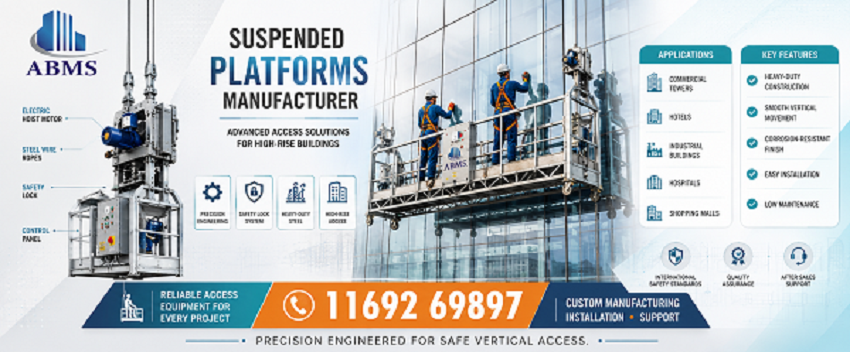
Suspended Platforms Manufacturer | High-Rise Building Access Solutions
A Suspended Platforms Manufacturer plays an important role in providing safe, efficient, and reliable access solutions for high-rise building maintenance. Modern commercial buildings, residential towers, hotels, hospitals, shopping malls, corporate offices, and industrial structures often feature glass façades and complex exterior designs. Maintaining these surfaces requires specialized equipment that can provide controlled access at height.
Suspended platforms, also known as suspended cradles, gondolas, or rope suspended platforms, are designed to provide workers with a stable working platform for exterior building activities. These systems are commonly used for glass cleaning, façade inspection, painting, waterproofing, window maintenance, repair work, and renovation projects.
ABMS Services provides suspended platform and façade access solutions designed around individual project requirements. Our approach focuses on equipment quality, practical system design, safety, installation, inspection, maintenance, and technical support. Selecting the right suspended platform is important because building height, façade configuration, platform capacity, roof structure, and frequency of use can all influence the appropriate system.
What Is a Suspended Platform?
A suspended platform is a mechanically supported working platform that hangs from wire ropes or other approved suspension arrangements. The platform can be raised and lowered along the exterior of a building using hoists or lifting equipment. It provides direct access to elevated façade surfaces that would otherwise be difficult or unsafe to reach.
Suspended platforms are particularly useful for buildings where conventional scaffolding is impractical. Instead of constructing a large temporary structure around the building, a suspended platform can provide access from the rooftop and move vertically along the façade.
The exact configuration of a suspended platform depends on the building and the intended application. Some systems are designed for temporary use, while others are incorporated into a building's permanent façade access strategy.
A professional Suspended Platforms Manufacturer evaluates the operational requirements before recommending a suitable system. Factors such as working height, platform length, safe working load, suspension arrangement, roof layout, façade profile, and required travel path should be considered during the design process.
How Does a Suspended Platform Work?
A typical suspended platform is connected to a suspension arrangement located on the rooftop or another suitable supporting structure. High-strength wire ropes are connected to the platform, and electric hoists control its vertical movement.
Operators use a control system to raise or lower the platform according to the requirements of the maintenance task. Depending on the system design, the platform can provide access to different areas of the façade.
The platform's safety equipment works together with the lifting system to provide controlled operation. Emergency stopping mechanisms, safety locks, overload protection, limit switches, and other protective devices may be incorporated according to the equipment design and applicable requirements.
Before operation, the system should be inspected and checked by trained personnel. Operators should follow the manufacturer's instructions and all applicable workplace-at-height procedures.
Why Choose a Professional Suspended Platforms Manufacturer?
Choosing an experienced Suspended Platforms Manufacturer is important because suspended access equipment must be suitable for the building and the intended working conditions. A properly designed system can improve maintenance efficiency while providing a practical solution for high-rise exterior access.
A professional manufacturer can assist with system selection, platform configuration, suspension requirements, safety equipment, installation planning, testing, and maintenance support.
ABMS Services focuses on delivering reliable façade access solutions that are designed according to project requirements. We understand that every building is different, so suspended platforms may need to be customized according to architectural and operational conditions.
Key Components of Suspended Platforms
A suspended platform consists of multiple components that work together to provide controlled and safe access. The configuration may vary depending on the equipment type and application.
1. Suspended Platform or Cradle
The cradle provides the working area for maintenance personnel. It is generally manufactured using durable materials and designed to support the specified working load. Platform dimensions can be selected according to the façade and project requirements.
2. Electric Hoists
Electric hoists provide the lifting mechanism required to move the platform vertically. Hoists should be selected according to platform capacity, building height, operating conditions, and the suspension configuration.
3. Wire Ropes
Wire ropes support the suspended platform and provide the connection between the lifting equipment and the working platform. Regular inspection is essential to identify wear, corrosion, deformation, or other conditions that may affect performance.
4. Suspension System
The suspension system supports the platform from an appropriate location on the building. Depending on the project, it may include roof-mounted equipment, davit arms, parapet arrangements, monorail systems, or other engineered solutions.
5. Control Panel
The control panel allows operators to control the platform's movement. Controls generally include operational functions and emergency stopping arrangements according to the system design.
6. Safety Devices
Safety devices may include emergency brakes, overload protection, safety locks, anti-tilt mechanisms, limit switches, and other protective equipment.
Benefits of Suspended Platforms
Safe Exterior Access
Suspended platforms provide controlled access to elevated building surfaces. When properly designed, installed, inspected, and operated, they can provide an effective method for performing maintenance at height.
Efficient Building Maintenance
Workers can access specific sections of the building façade without constructing extensive scaffolding. This can improve productivity during cleaning, repair, and inspection activities.
Flexible Application
Suspended platforms can be used for a variety of exterior maintenance activities. Depending on the configuration, the same platform can support different tasks such as cleaning, painting, inspection, and repair.
Reduced Scaffolding Requirements
High-rise buildings may require substantial scaffolding when traditional methods are used. Suspended platforms can provide an alternative access arrangement for many façade maintenance applications.
Cost-Effective Maintenance
A properly selected suspended platform can reduce the time and resources required for repeated exterior maintenance. This can make it a practical long-term investment for buildings requiring regular façade access.
Suitable for Modern Buildings
Suspended platforms are suitable for many modern structures featuring glass curtain walls, aluminum cladding, composite panels, windows, and other architectural surfaces.
Applications of Suspended Platforms
Suspended platforms are used across many industries for exterior building access. Their applications include both routine maintenance and specialized construction activities.
Glass Cleaning
High-rise glass façades require regular cleaning to maintain appearance and transparency. A suspended platform allows cleaning personnel to access elevated glass surfaces efficiently.
Facade Maintenance
Building exteriors require regular inspection and repair. Suspended platforms provide workers with access to façade surfaces for maintenance activities.
Exterior Painting
Suspended platforms can provide access for exterior painting and coating applications on tall structures.
Waterproofing
Exterior waterproofing often requires access to wall joints, cracks, windows, and other elevated areas. Suspended platforms can support these maintenance operations.
Window Maintenance
Suspended platforms can be used for window cleaning, inspection, repair, and replacement activities where appropriate.
Facade Inspection
Regular façade inspections help identify visible defects and maintenance requirements. A suspended platform can provide close access for inspection personnel.
Renovation Projects
During renovation and refurbishment, workers may need access to exterior surfaces for repairs, painting, cladding work, and other activities.
Suspended Platforms for High-Rise Buildings
High-rise buildings require carefully planned access systems because exterior surfaces can be located many metres above ground level. Suspended platforms offer a practical way to reach these surfaces from the rooftop.
For a high-rise project, the system should be designed after considering the building's height, roof structure, façade geometry, required platform reach, safe working load, environmental conditions, and maintenance schedule.
Buildings with large glass façades can particularly benefit from suspended platforms because regular cleaning and inspection are important for maintaining the appearance and condition of the property.
Safety Features of Suspended Platforms
Safety is one of the most important considerations when selecting a suspended platform. Modern equipment may incorporate multiple safety systems designed to reduce operational risks.
Emergency Stop
Emergency stop controls allow the operator to stop equipment movement when an abnormal situation occurs.
Overload Protection
Overload protection helps prevent operation beyond the specified working capacity.
Safety Lock
Safety locking devices can provide additional protection in specific abnormal operating conditions.
Anti-Tilt Protection
Anti-tilt arrangements help maintain platform stability during operation.
Limit Switches
Limit switches can help control travel and prevent movement beyond designated operating limits.
Fall Protection
Appropriate fall protection equipment and anchorage arrangements should be provided according to the system design and applicable safety requirements.
Safety systems should never be considered a replacement for proper operator training, pre-use inspection, engineering design, and safe working procedures.
Suspended Platform Manufacturer for Facade Maintenance
A reliable Suspended Platforms Manufacturer can provide systems specifically designed for façade maintenance. Modern buildings may have straight, curved, recessed, or irregular façades, which can influence the access equipment required.
The platform length, suspension arrangement, hoisting capacity, control system, and support structure can be selected according to the building's requirements.
ABMS Services provides customized suspended platform solutions for different types of buildings. Our objective is to provide practical equipment that supports safe, efficient, and reliable façade maintenance.
Suspended Platform vs Traditional Scaffolding
Traditional scaffolding remains useful for many construction and maintenance applications, but it can require significant installation time and material. Suspended platforms offer a different approach by providing access from above.
| Feature | Suspended Platform | Traditional Scaffolding |
|---|---|---|
| Installation | Generally faster for suitable applications | Can require extensive assembly |
| Vertical Movement | Powered movement | Requires movement within scaffold levels |
| High-Rise Access | Suitable for many high-rise maintenance applications | Can require substantial structure |
| Flexibility | High for suitable facade configurations | Depends on scaffold arrangement |
| Storage | Requires equipment storage | Requires significant scaffold material |
The appropriate access method should always be selected according to the building, work scope, safety requirements, and project conditions.
Suspended Platform Rental Services
Purchasing a suspended platform may not be practical for every contractor or maintenance company. For short-term projects, a Rope Suspended Platform Rental Service can provide access to suitable equipment without requiring a large capital investment.
Rental services may be useful for construction projects, temporary renovation work, façade cleaning contracts, painting projects, and other activities with a defined project duration.
Before renting equipment, clients should verify platform capacity, inspection status, safety equipment, installation requirements, and operator training requirements.
Installation of Suspended Platforms
Proper installation is essential for the safe and reliable operation of suspended platforms. The installation process depends on the type of suspension system and building configuration.
Before installation, the supporting structure should be evaluated by competent professionals. The suspension points, roof structure, access route, platform configuration, and required operating area should be considered.
After installation, the equipment should be inspected and tested according to applicable requirements and manufacturer instructions before being placed into regular service.
Maintenance of Suspended Platforms
Regular maintenance is essential for reliable performance. A preventive maintenance program should include inspection of the platform structure, trolley or suspension components, fasteners, wire ropes, hoists, electrical controls, safety locks, and other safety devices.
Operators should report unusual noises, vibration, uneven movement, rope damage, electrical faults, or other abnormalities immediately. Preventive maintenance can identify potential problems before they become serious operational issues.
Maintenance activities should be performed by competent personnel according to the manufacturer's recommendations and applicable regulations.
Important Maintenance Checks
- Inspect wire ropes for visible damage.
- Check hoist operation.
- Inspect electrical connections.
- Test emergency stop functions.
- Check safety locks.
- Inspect platform structure.
- Check fasteners and mechanical connections.
- Inspect suspension equipment.
- Maintain inspection records.
Factors to Consider When Selecting a Suspended Platform
Selecting the right suspended platform requires careful evaluation of the project. Building owners and contractors should consider the following factors.
Building Height
The required lifting height influences the hoisting equipment, wire rope length, and overall system configuration.
Platform Capacity
The safe working load should be appropriate for the number of workers, tools, and materials intended to be carried.
Facade Design
Curved, recessed, or irregular façades may require specialized access arrangements.
Roof Configuration
The available rooftop area and supporting structure must be considered when selecting a suspension system.
Frequency of Use
Buildings requiring regular maintenance may benefit from a permanent access system, while temporary projects may be better suited to rental equipment.
Safety Requirements
Safety should always be a primary selection criterion. The equipment should be suitable for the intended application and operated according to applicable requirements.
Industries Using Suspended Platforms
Suspended platforms are used in a wide range of industries and building types.
- Commercial office buildings
- Residential high-rise towers
- Hotels and resorts
- Hospitals
- Shopping malls
- Airports
- Educational institutions
- Corporate buildings
- Industrial facilities
- Mixed-use developments
- Government buildings
- Institutional buildings
Customized Suspended Platform Solutions
Every building has different maintenance requirements. A customized suspended platform solution can provide better access where standard equipment may not be suitable.
Customization may involve platform dimensions, suspension arrangements, control systems, wire rope configuration, rooftop equipment, and other project-specific requirements.
ABMS Services works with clients to understand their building configuration and maintenance objectives before recommending a suitable suspended platform solution.
Importance of Operator Training
Even a well-designed suspended platform requires trained operators. Workers should understand equipment controls, load limitations, inspection procedures, emergency actions, fall protection, and safe working practices.
Operators should inspect the equipment before use and immediately report any abnormal condition. Only authorized and appropriately trained personnel should operate suspended access equipment.
Cost of Suspended Platforms
The cost of a suspended platform depends on several factors. These may include platform size, working load, lifting height, hoist specifications, wire rope arrangement, suspension system, safety equipment, customization, installation, testing, and maintenance requirements.
A low initial purchase price should not be the only consideration. Building owners should also evaluate safety, durability, service availability, spare parts, maintenance requirements, operational efficiency, and long-term value.
ABMS Services can help clients identify a suitable configuration according to the requirements of their building and project.
Permanent Suspended Platform Systems
Permanent suspended platform systems are incorporated into a building's long-term maintenance strategy. They can be useful for buildings where regular façade cleaning and inspection are required throughout the year.
Permanent systems should be considered during the building design stage whenever possible. Early planning can make it easier to coordinate structural supports, rooftop access, electrical requirements, and façade geometry.
Temporary Suspended Platforms
Temporary suspended platforms are suitable for construction, renovation, painting, repair, and other projects where access is required for a limited period.
Temporary systems can provide flexibility because equipment can be installed for the duration of the project and removed after completion. Proper installation and inspection remain essential regardless of how long the equipment is used.
Suspended Platforms for Glass Cleaning
Glass façades require regular cleaning to maintain the appearance of a building. Suspended platforms allow cleaning teams to access exterior glass surfaces at different elevations.
For large commercial towers and residential buildings, regular glass cleaning can become an important part of facility management. A dedicated access platform can make recurring cleaning operations more efficient.
Suspended Platforms for Building Maintenance
Building maintenance includes much more than cleaning. Exterior surfaces can require periodic inspection, sealant replacement, waterproofing, painting, repairs, and component replacement.
A suspended platform provides a working position close to the façade, allowing maintenance personnel to perform these tasks with greater accessibility.
Proper maintenance planning can also help identify defects at an early stage and reduce the possibility of larger repair requirements in the future.
Environmental and Operational Advantages
Suspended platforms can reduce the amount of temporary construction material required for certain maintenance projects. Because the system is suspended from above, it can reduce the need for extensive ground-supported access structures.
Faster access and improved work positioning can also help maintenance teams complete certain projects efficiently. This can reduce disruption around buildings and improve overall project planning.
Why ABMS Services?
ABMS Services provides façade access and suspended platform solutions for high-rise building maintenance requirements. Our focus is on providing dependable equipment and practical solutions based on the individual needs of each project.
From suspended platforms and cradle systems to davit systems and monorail-based façade access solutions, ABMS Services can support different building maintenance requirements.
- Project-specific suspended platform solutions
- Professional technical guidance
- Quality-focused equipment selection
- Installation support
- Inspection and maintenance assistance
- Safety-focused system design
- Technical support
- After-sales service
Frequently Asked Questions
What is a suspended platform?
A suspended platform is a working platform supported by wire ropes or an engineered suspension system and used to provide access to building exteriors for cleaning, inspection, repair, painting, and maintenance.
What is a suspended platform used for?
Suspended platforms are commonly used for glass cleaning, façade maintenance, painting, waterproofing, inspection, window maintenance, repair, and renovation work.
Who is a Suspended Platforms Manufacturer?
A Suspended Platforms Manufacturer designs and supplies suspended access equipment for high-rise and multi-storey building maintenance applications. ABMS Services provides suspended platform and façade access solutions according to project needs.
Are suspended platforms suitable for high-rise buildings?
Yes. Suspended platforms can be suitable for many high-rise buildings when the system is properly designed, installed, inspected, and operated according to applicable requirements.
Can suspended platforms be customized?
Yes. Platform dimensions, suspension arrangements, lifting equipment, controls, and other features can be selected according to building and project requirements.
What safety features are available?
Depending on the system, safety features may include emergency stops, overload protection, safety locks, anti-tilt devices, limit switches, fall protection arrangements, and other protective systems.
Can suspended platforms be rented?
Yes. Suspended platforms can be rented for temporary construction, maintenance, painting, cleaning, and renovation projects where purchasing equipment is not necessary.
How often should suspended platforms be maintained?
Maintenance and inspection frequency should follow manufacturer recommendations, applicable regulations, equipment usage, and site conditions. Regular inspection is essential for safe operation.
What buildings can use suspended platforms?
Commercial towers, residential buildings, hotels, hospitals, shopping centres, airports, educational institutions, industrial buildings, and other multi-storey structures can use suitable suspended platform systems.
Why choose ABMS Services?
ABMS Services provides customized façade access solutions, technical support, installation assistance, and maintenance services designed around individual project requirements.
Conclusion
A Suspended Platforms Manufacturer provides an important solution for modern high-rise building maintenance. Suspended platforms offer practical access for cleaning, inspection, painting, waterproofing, repair, glass maintenance, and renovation work.
Compared with extensive temporary access structures, suspended platforms can provide efficient vertical access while supporting a wide range of exterior maintenance activities. Their effectiveness depends on correct system selection, professional installation, regular inspection, proper maintenance, and trained operation.
When selecting a suspended platform, building owners should consider the building height, façade design, roof configuration, platform capacity, suspension arrangement, safety requirements, maintenance frequency, and overall project objectives.
ABMS Services provides reliable suspended platform and façade access solutions designed to meet the requirements of modern buildings. Our focus on customized solutions, safety, quality, installation support, and maintenance helps clients develop efficient access systems for their high-rise maintenance needs.
For commercial towers, residential complexes, hotels, hospitals, industrial facilities, and other multi-storey buildings, a properly planned suspended platform can provide dependable access for essential exterior maintenance. Contact ABMS Services to discuss your project requirements and identify a suitable suspended platform solution.